Choosing between a tankless and a traditional tank water heater is one of the most significant plumbing decisions a Seattle homeowner can make. The right choice depends on your household’s hot water usage, your home’s infrastructure, your budget, and your long-term energy goals. With Seattle’s commitment to energy efficiency and our relatively mild climate, both options have distinct advantages worth understanding.
At Bee’s Plumbing & Heating, we install both tankless and tank water heaters every week. This comprehensive comparison breaks down the real costs, performance differences, and long-term value of each option based on our experience serving Seattle homeowners.
How Tank Water Heaters Work
A traditional tank water heater is the most common type found in Seattle homes. It works by continuously heating and storing a reservoir of hot water, typically between 40 and 80 gallons, so it’s ready whenever you need it.
The tank is insulated to retain heat, but even the best-insulated tanks lose heat over time, a phenomenon known as standby heat loss. The burner or heating element cycles on periodically throughout the day to maintain the set temperature, consuming energy even when no one is using hot water.
Modern tank water heaters have become significantly more efficient than models from even a decade ago. Current models feature improved insulation, more efficient burners, and electronic ignition systems that eliminate the energy waste of a standing pilot light. The most efficient tank models available today achieve Uniform Energy Factor (UEF) ratings of 0.70 or higher for gas models and 0.90 or higher for electric models.
How Tankless Water Heaters Work
Tankless water heaters, also called on-demand or instantaneous water heaters, heat water only when a hot water tap is opened. When you turn on a faucet, cold water travels through the unit, where a gas burner or electric heating element heats it to the set temperature in seconds. When the tap is closed, the unit shuts off completely.
This on-demand approach eliminates standby heat loss entirely. However, tankless units require a significantly higher energy input during operation because they must heat water from cold to hot almost instantaneously. A typical gas tankless unit uses 150,000 to 199,000 BTUs compared to 40,000 BTUs for a standard tank unit, though it runs for much shorter periods.
Upfront Cost Comparison
The initial investment is where the biggest difference between these two options becomes apparent.
Tank Water Heater Costs
A standard 50-gallon gas tank water heater typically costs between $800 and $1,500 for the unit itself. Professional installation in the Seattle area, including permits, typically runs $800 to $1,500, bringing the total project cost to roughly $1,600 to $3,000 for a straightforward replacement where the existing infrastructure is compatible.
Electric tank water heaters are generally less expensive to purchase, ranging from $600 to $1,200 for the unit, with similar installation costs. However, operating costs are typically higher due to Seattle City Light’s electricity rates compared to Puget Sound Energy’s natural gas rates.
High-efficiency tank models and heat pump water heaters cost more upfront, ranging from $1,500 to $3,500 for the unit, but qualify for various rebates and offer substantially lower operating costs.
Tankless Water Heater Costs
A whole-house gas tankless water heater typically costs between $1,500 and $3,000 for the unit. Installation costs in Seattle are notably higher than tank units due to several factors. The gas line usually needs to be upgraded to a larger diameter to handle the higher BTU demand. The venting system requires stainless steel category III or IV vent pipe instead of standard B-vent. Condensate drainage must be installed for condensing models. And electrical connections are needed for the electronic controls.
Total installed cost for a gas tankless water heater in Seattle typically ranges from $3,500 to $6,500, depending on the complexity of the installation. Retrofitting a tankless unit into a home that previously had a tank water heater is almost always on the higher end of this range due to the infrastructure upgrades required.
Electric tankless whole-house units are less common because Seattle homes typically don’t have the electrical capacity they require, which is often 150 to 200 amps of dedicated service. Adding this capacity can cost thousands of dollars in electrical panel upgrades.
Operating Cost Comparison
This is where tankless water heaters begin to close the gap on their higher upfront cost.
Energy Consumption
The U.S. Department of Energy estimates that tankless water heaters are 24 to 34 percent more energy-efficient than conventional storage tank water heaters for homes that use 41 gallons or less of hot water per day. For homes that use more, around 86 gallons per day, tankless units are about 8 to 14 percent more efficient.
For a typical Seattle household of three to four people, annual gas costs for a tank water heater average $350 to $500. A comparable tankless unit reduces this to roughly $250 to $380 annually, a savings of $100 to $150 per year on average.
Electric rates in Seattle are relatively low compared to the national average, thanks to the city’s hydroelectric power. However, the high electrical demand of whole-house electric tankless units can spike your bill during heavy usage periods.
Maintenance Costs
Both types require regular maintenance, but the nature and cost differ. Tank water heaters need an annual sediment flush, which costs $100 to $200 if done professionally, and periodic anode rod replacement at $150 to $300 every three to five years.
Tankless water heaters require annual descaling (flushing with vinegar solution) to remove mineral buildup from the heat exchanger, which costs $150 to $300 professionally. In Seattle, our water is relatively soft compared to many U.S. cities, so descaling may be needed less frequently, but it should never be skipped entirely.
Performance Comparison
Beyond cost, the daily performance of your water heater significantly impacts your quality of life.
Hot Water Capacity
A 50-gallon tank water heater delivers its full tank of hot water at a high flow rate and can typically supply two to three simultaneous fixtures before running out. Once depleted, recovery time is 30 to 60 minutes for gas models and 60 to 90 minutes for electric. For a family that staggers showers, this is rarely an issue. For a household where everyone showers in the morning, you may occasionally run out.
Tankless units provide a continuous supply of hot water and never run out. However, they are limited by flow rate rather than volume. A typical residential gas tankless unit delivers 8 to 11 gallons per minute (GPM) in Seattle, where incoming water temperature averages 50 to 55 degrees. This is enough for two to three simultaneous fixtures, but trying to run three showers while doing laundry may exceed the unit’s capacity, resulting in a temperature drop.
Hot Water Delivery Speed
Neither tank nor tankless water heaters deliver instant hot water at the tap. The wait time is primarily determined by the distance between the water heater and the fixture. A tank water heater begins delivering hot water immediately from its reservoir, with the only delay being the time for hot water to travel through the pipes.
Tankless units add a brief additional delay of two to five seconds while the unit fires up and brings the water to temperature. This “cold water sandwich” effect can be noticeable, particularly when fixtures are used intermittently. Some tankless models include a small internal buffer tank or recirculation capability to minimize this delay.
For homes where hot water delivery speed is a priority, a recirculating pump can be added to either type of water heater to provide near-instant hot water at frequently used fixtures.
Space Requirements
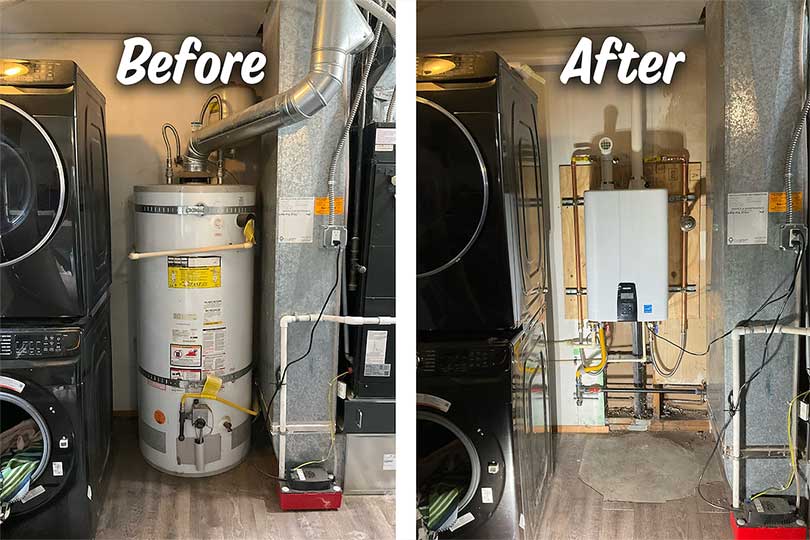
Tank water heaters occupy significant floor space. A 50-gallon model is roughly 60 inches tall and 24 inches in diameter, requiring a dedicated area in a utility closet, garage, or basement. They must also maintain specific clearances for venting and service access.
Tankless units are dramatically smaller, typically about the size of a carry-on suitcase, and mount on a wall. This frees up valuable floor space, which is particularly appealing in Seattle’s smaller homes, condos, and townhouses where every square foot counts. Many tankless units can even be installed outdoors with a freeze protection kit, freeing up interior space entirely.
Lifespan and Long-Term Value
The longevity of your water heater directly impacts the true cost of ownership over time.
Tank Water Heater Lifespan
A well-maintained tank water heater typically lasts 8 to 12 years in the Seattle area. Factors that affect lifespan include water quality, maintenance frequency, and how hard the unit works. Homes with higher hot water demand or those that skip regular maintenance often see their tank water heater fail closer to the 8-year mark.
When a tank water heater fails, it often does so by leaking, which can cause significant water damage if not caught quickly. This risk increases as the unit ages, which is why we recommend proactive replacement at 10 to 12 years rather than waiting for failure.
Tankless Water Heater Lifespan
Tankless water heaters have a significantly longer expected lifespan of 15 to 20 years or more with proper maintenance. Most major components, including the heat exchanger, can be individually replaced without replacing the entire unit, further extending its useful life.
This longer lifespan is a key factor in the long-term value proposition of tankless water heaters. While the upfront cost is higher, you may go through two tank water heaters in the same period that a single tankless unit serves your home.
Total Cost of Ownership: 20-Year Comparison
Let’s put it all together with a realistic 20-year cost comparison for a typical Seattle household of four.
Tank Water Heater (20 Years)
Over 20 years, you’ll likely need two tank water heaters. The first installation runs $2,000 to $2,800, and the second replacement at year 10 to 12 costs $2,000 to $2,800 again. Annual operating costs of $400 average over 20 years total $8,000. Maintenance over 20 years adds approximately $2,000 to $3,000. The grand total comes to roughly $14,000 to $16,600 over 20 years.
Tankless Water Heater (20 Years)
A single tankless installation costs $4,000 to $6,000, with the unit likely lasting the full 20-year period. Annual operating costs of $300 average over 20 years total $6,000. Maintenance over 20 years adds approximately $3,000 to $4,000, including one potential heat exchanger service. The grand total comes to roughly $13,000 to $16,000 over 20 years.
The 20-year costs are remarkably similar, which means the decision often comes down to factors beyond pure economics.
Rebates and Incentives in Seattle
Several rebates and incentives can tip the financial balance for Seattle homeowners.
Puget Sound Energy offers rebates for qualifying high-efficiency gas water heaters, including both tank and tankless models. Seattle City Light and Washington State offer rebates for heat pump water heaters, which are the most efficient tank-style option. Federal tax credits are available for qualifying energy-efficient water heaters, including heat pump and high-efficiency gas models. Some manufacturers offer additional rebates when you purchase qualifying models.
Your Bee’s Plumbing & Heating technician can help you identify which rebates apply to your specific situation and assist with the application process.
Which Is Right for Your Seattle Home?
Based on our experience installing thousands of water heaters across the Seattle area, here are our recommendations based on household profile.
A Tank Water Heater May Be Best If:
You have a limited upfront budget, your current gas and venting infrastructure is compatible, your household’s hot water usage is moderate and predictable, you’re planning to sell your home in the next few years and want to minimize capital outlay, or your home’s gas line cannot easily be upgraded.
A Tankless Water Heater May Be Best If:
You plan to stay in your home long-term and want to maximize lifetime value, your household has high or unpredictable hot water demand, you want to reclaim floor space in a smaller Seattle home, you value the environmental benefits of reduced energy consumption, or you’re building new or doing a major renovation where infrastructure can be designed for tankless from the start.
Get a Personalized Recommendation
Every home is different, and the best water heater choice depends on your specific circumstances. At Bee’s Plumbing & Heating, we don’t push one type over the other. Our licensed plumbers evaluate your home’s infrastructure, your family’s hot water needs, and your budget to recommend the option that makes the most sense for you.
Contact us today for a free in-home water heater consultation. We’ll assess your current system, discuss your options, and provide a transparent quote with no hidden fees. Whether you choose tank or tankless, you’ll get expert installation backed by our satisfaction guarantee.
Need Professional Plumbing or Heating Help?
Our expert technicians are ready to assist you with any plumbing, heating, or drain needs.